Security events
Security shows trusted observations from the data plane. An access denial, a WAF decision, a CrowdSec block and an upstream error are produced by different components; a status code alone never identifies which one produced it. The event view does.
What is stored
| Kind | Produced by | Notable detail |
|---|---|---|
ACL_DENY | Access policy | The winning rule: deny:<CIDR> or default-deny |
WAF_MATCH | WAF in monitor mode | The matched rule id; the request was forwarded |
WAF_BLOCK | WAF in block mode | The matched rule id, joined from the engine's audit record |
CROWDSEC_BLOCK | CrowdSec enforcement | The client address under an active decision |
UPSTREAM_ERROR | Gateway ↔ origin | Unavailable upstream (502/503), timeout (504) or another gateway failure |
The client address is the one the data plane resolved for the decision. A forwarding header sent by an untrusted peer cannot change it. Request bodies, credentials, cookies and raw match values are never stored.
Requests that the application itself answered — including its own 403 or 500 — are
not gateway events and do not appear here.
Filtering
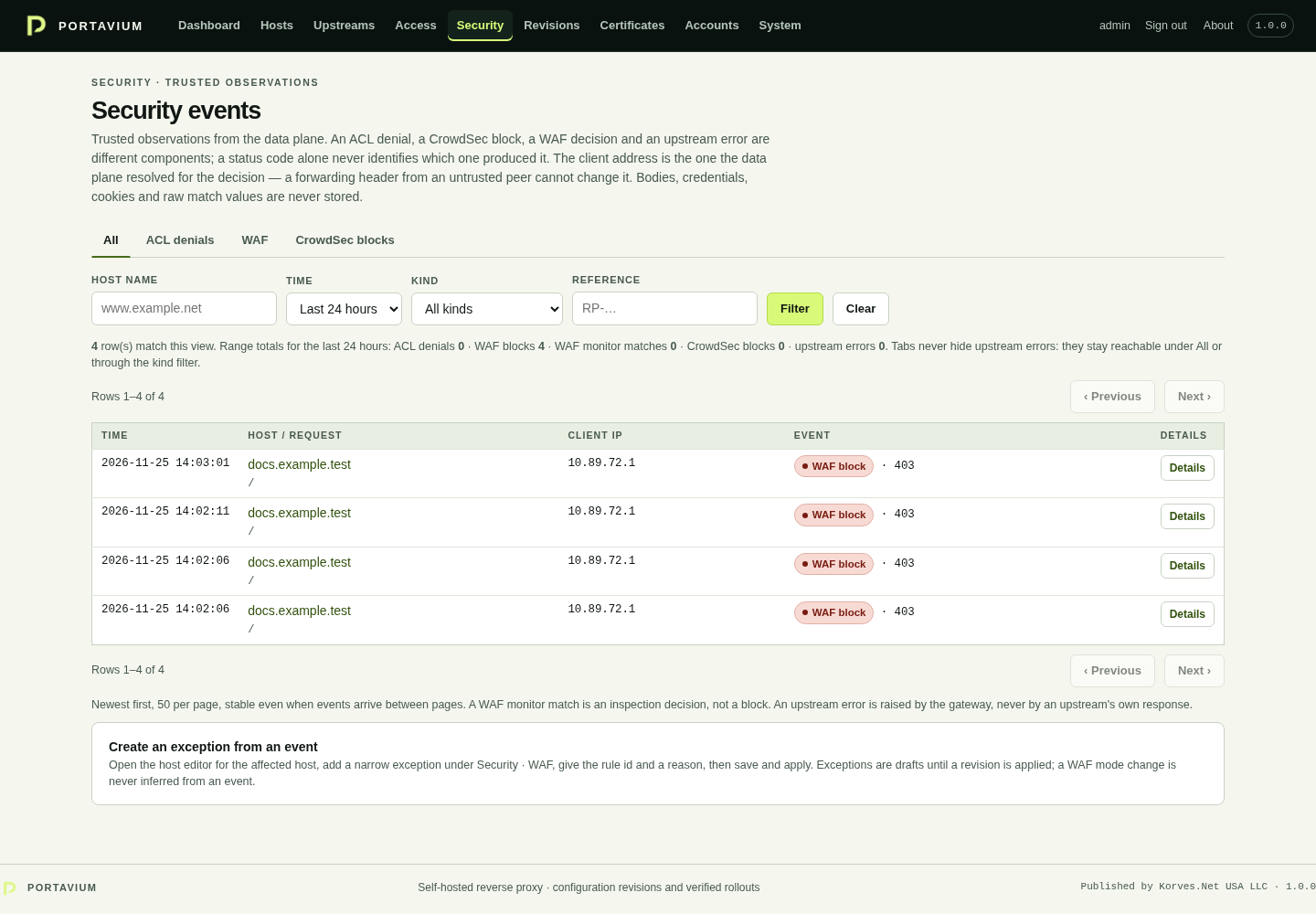
Use the tabs or the filter form:
- Tabs — All, ACL denials, WAF, CrowdSec blocks. Tabs never hide upstream errors; they stay reachable under All or through the kind filter.
- Host name — narrow to one host.
- Time — last hour, last 24 hours or last 7 days.
- Kind — one event kind.
- Reference — look up one request by its
RP-…reference.
The summary line reports how many rows match the view and the range totals for each kind, so a tab's count is not confused with the whole range.
Tracing a block page
A visitor-facing PORTAVIUM error page shows an opaque reference such as RP-…. It is
the engine's own per-request identifier and contains no address, port or host name.
To trace it:
- Copy the reference from the page.
- Open Security and paste it into Reference.
- Submit the filter.
The matching event shows the time, the host and request path, the client address, the event kind and its status. For a WAF block the rule id is included; for an access denial the winning rule is included. This is how you distinguish "the WAF blocked it" from "the access policy blocked it" from "the origin was unavailable" for one request.
The same reference also identifies the request in the node's detailed WAF record
(/data/caddy/waf-audit.log), which stays on the node and is not stored centrally.
API clients
An API client that sends Accept: application/json receives a minimal JSON object from
a gateway-generated error instead of the HTML page:
{"error": {"kind": "waf_blocked", "message": "This request was blocked", "reference": "RP-…"}}
The shape is the same for every gateway-generated error; kind distinguishes the
component (access_denied, waf_blocked, crowdsec_blocked, upstream_unavailable,
gateway_timeout, gateway_error, host_not_configured).